
The J. Dow ball tack test uses an inclined plane to compare the initial tack of pressure-sensitive tapes and sheets. Steel balls of different sizes roll down an incline onto the exposed adhesive. The result is the number of the largest ball that stops within the test area and meets the method’s stopping rule.
What Does the Inclined Ball Tack Test Measure?
JIS Z 0237:2022, Clause 14, covers inclined ball tack. The ball first rolls along an approach section, then enters a defined area of exposed adhesive on the incline. Under the same setup and specimen conditions, a higher ball number means the sample stopped a larger ball and showed higher tack in this test. The ball number identifies a size in the test set; it does not express force or stopping distance.
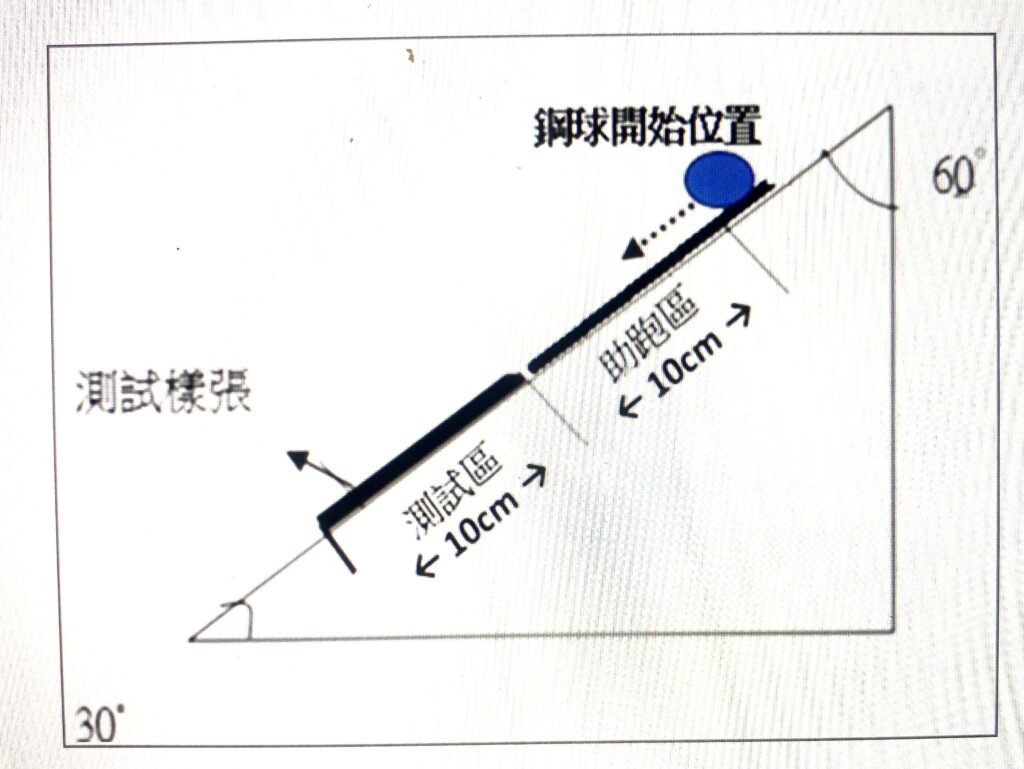
How to Run the J. Dow Ball Tack Test
- Set up the tester. Use the ramp angle, approach length, test area and steel ball set specified in the applicable procedure. Check that the ramp and balls are clean and dry.
- Prepare the specimen. Condition the tape or sheet as specified, then mount it flat with the adhesive side up. Keep the test area free of fingerprints, dust and wrinkles.
- Release the balls. Start each ball from the prescribed position without pushing it. Follow the procedure for ball selection and repeat runs. A ball that pauses and rolls out of the test area does not count as a stop.
- Confirm and record the result. Identify the largest ball that meets the stopping rule. Use the required confirmation runs and reporting method. This overview explains the test; use the full applicable standard or agreed procedure for the exact settings and acceptance criteria.
How to Read and Report the Ball Number
In an illustrative J. Dow ball tack test, suppose Sample A stops ball No. 12 and Sample B stops ball No. 16 under identical conditions. If those are the largest confirmed stops, Sample B shows higher inclined ball tack in that comparison. The difference does not mean its tack is a third higher: the numbers identify ball sizes, not a linear scale of adhesive performance. These values are illustrative and are not Chemix Guru test data.
Record the method and edition, ramp angle, sample or lot ID, backing and adhesive thickness if known, and conditioning and test environment. Keep the individual observations and note any deviations. For comparisons across lots, keep the specimen construction and setup consistent. If an unusually large ball stops once but the result does not repeat, check for contamination, wrinkles, or a change in the release point before drawing a conclusion.
J. Dow Ball Tack Test vs. Distance-Based Rolling Ball Tack
Both methods start with a ramp. They differ in where the ball contacts the adhesive, how the ball is selected, and what the test reports.
| Test detail | J. Dow (JIS Z 0237) | Distance method (ASTM D3121) |
|---|---|---|
| Specimen position | Adhesive faces up on the incline, after the approach section. | Adhesive faces up on a level surface beyond the ramp. |
| Steel ball | Test balls of different sizes. | Use one specified ball size. |
| Result | Largest ball number that meets the stopping rule within the test area. | Distance from the end of the ramp to the stopping point. |
| Higher tack within the same setup | Larger stopping ball number. | Shorter stopping distance. |
The ball number and stopping distance cannot be converted directly because the setups and measured quantities differ. If a specification calls for one method, report the result from that method. See our distance-based rolling ball tack test guide for the procedure and its limits.
What the Result Can Tell You
Use the J. Dow ball tack test to screen samples or check for changes between comparable batches. A result on a steel ball cannot tell you how well a label will grab a textured carton or whether a protective film will lift cleanly from the finished part. Test on the actual substrate when initial grab matters in production. Add peel or shear testing when resistance to removal or holding under a sustained load is part of the requirement.
Choosing an adhesive for a tape, label or protective film? Browse our solvent-based acrylic pressure-sensitive adhesives, including an acrylic PSA for protective film. Contact Chemix Guru with your substrate, coating construction, and target application so we can discuss which adhesive properties to evaluate.
References
- Japanese Standards Association: JIS Z 0237:2022, Clause 14.
- Yasuda Seiki: Inclined ball tack tester and measurement principle.
- ASTM D3121: Tack of pressure-sensitive adhesives by rolling ball.
- ChemInstruments: Rolling ball tack tester setup and distance measurement.