
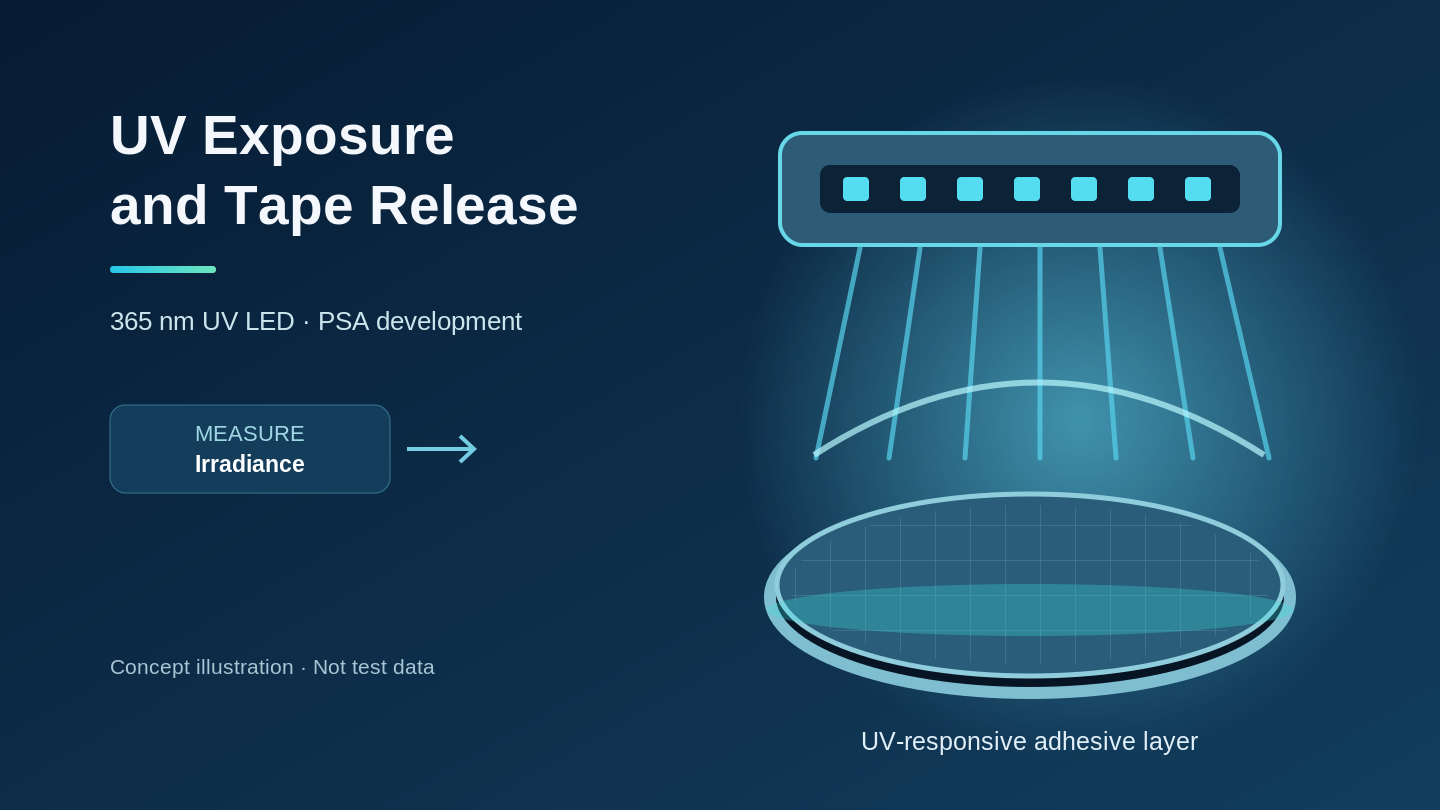
Evaluating light exposure, peel force, and production constraints for semiconductor tape development
UV dose and exposure time for UV-release PSA are not simply settings on a laboratory UV lamp. They help determine whether a tape can reach its specified release condition on the equipment already installed on a production line. A low post-UV peel value is useful, but it becomes a practical material option only when the same performance can be reproduced within the available process window.
Chemix Guru develops acrylic pressure-sensitive adhesive (PSA) systems for tape manufacturers evaluating controlled UV release. When customers compare formulations, we recommend looking at measured irradiance, exposure duration, residual adhesion, and equipment cycle time together rather than relying on a single UV-dose number.
Why UV dose and exposure time for UV-release PSA matter
A UV-release tape needs to hold a wafer or component during processing, then release at a controlled peel force when the next step begins. The target is application-dependent. Some die pick-up operations call for very low residual adhesion, while others require a small amount of tack to remain after irradiation.
The required release condition must fit the irradiation station’s available cycle. For material-selection considerations in wafer singulation, see UV-Release Acrylic Adhesive for Dicing Tape.
Irradiance, UV dose, and exposure time: three different quantities
UV irradiance is the radiant power received per unit area at a defined measuring plane. It is usually reported in mW/cm². UV dose (more precisely, radiant exposure) is the energy delivered per unit area over time, usually reported in mJ/cm². Exposure time is how long the material receives the light.
Under the simplified assumption of constant irradiance at the tape surface:
UV Dose (mJ/cm²) = Irradiance (mW/cm²) × Exposure Time (s)
And therefore:
Exposure Time (s) = Target UV Dose (mJ/cm²) ÷ Irradiance (mW/cm²)
For moving webs, uneven UV fields, or pulsed lamps, irradiance can change over time. In those cases, accumulated dose must be determined from the irradiance profile rather than one average reading. The measurement plane, instrument wavelength sensitivity, and film transmission are also relevant. See this independent guide to measuring irradiance and radiant exposure.
If a lamp is labelled 100 mW/cm² but the relevant measurement plane gives 50 mW/cm², delivering 300 mJ/cm² takes 6 seconds at the measured value. Record the measurement position, especially when light passes through a backing film before reaching the adhesive.
Example: Calculating UV Exposure Time at Constant Irradiance
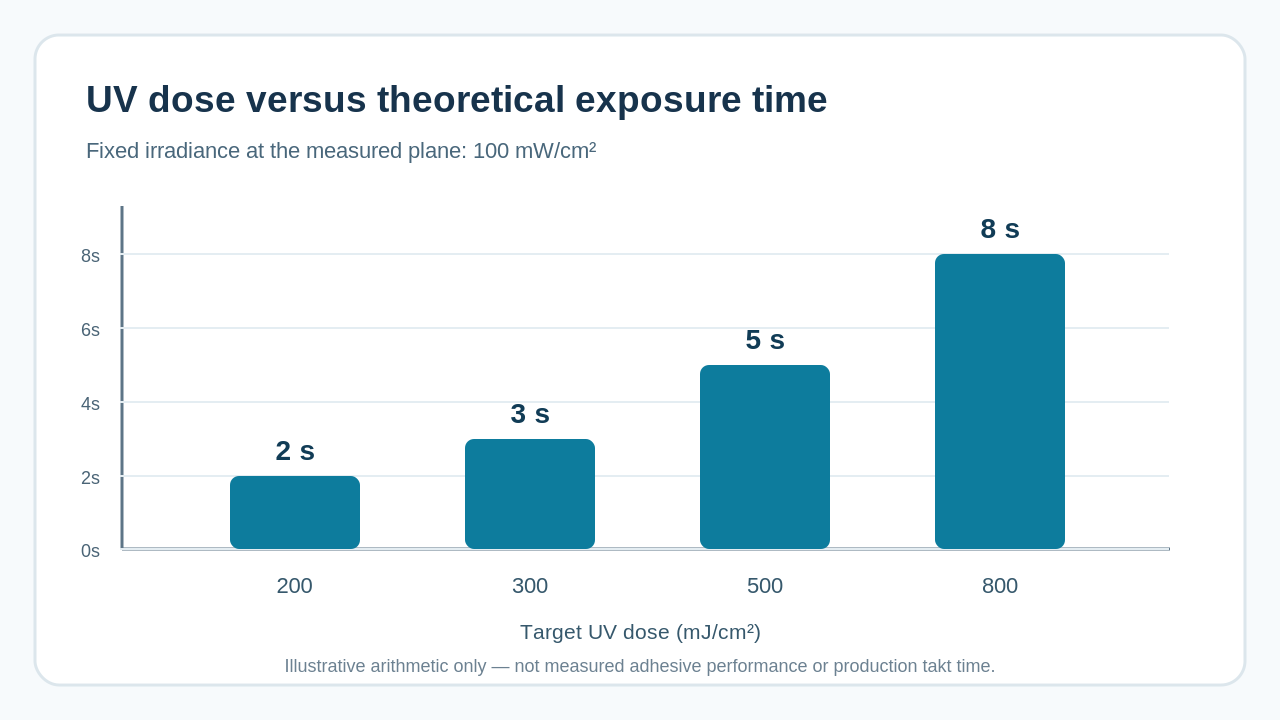
Suppose a UV LED system delivers a constant 100 mW/cm² at the measurement plane. The following times are calculated from the equation above:
| Illustrative target UV dose | Theoretical exposure time |
|---|---|
| 200 mJ/cm² | 2 seconds |
| 300 mJ/cm² | 3 seconds |
| 500 mJ/cm² | 5 seconds |
| 800 mJ/cm² | 8 seconds |
Illustrative calculations only. These values are not product specifications, measured release curves, or predicted adhesion results.
Try the UV exposure time calculator
Change irradiance and target dose to compare the calculated exposure times.
UV Exposure Time Calculator
Estimate exposure time from irradiance and target UV dose under a constant-irradiance assumption.
Irradiance measured at the relevant tape or adhesive plane.
Theoretical exposure time
3.00 s
UV dose ÷ irradiance
For illustration only. Actual irradiance can vary with wavelength, measurement geometry and time. This tool does not predict residual peel adhesion, machine cycle time, or takt time.
Does the same dose always give the same residual adhesion?
No. An exposure of 100 mW/cm² for 3 seconds and one of 300 mW/cm² for 1 second both deliver a calculated 300 mJ/cm², but adhesive response also depends on spectrum, irradiance, coating thickness, film transmission, temperature, and the interval before testing. This technical discussion of exposure non-reciprocity explains why equal accumulated energy can produce different material responses.
A release specification therefore needs both UV conditions and peel-test conditions. A target such as “below 10 gf/in (0.010 kg/in)” should identify the test surface, peel angle, speed, conditioning, and time after exposure. Specify an acceptable range when the process requires some residual tack.
From exposure time to equipment cycle time and takt time
- Exposure time is the duration of UV irradiation.
- Equipment cycle time includes the station’s relevant handling, alignment, irradiation, and unloading operations.
- Takt time is available production time divided by customer demand.
In a sequential station, 3 seconds of irradiation plus 4 seconds of handling gives a 7-second cycle. Reducing irradiation to 1 second gives a 5-second cycle when the handling sequence is unchanged. For comparison, 28,800 available seconds and demand for 3,600 units give an 8-second takt. Equipment trials should also record overlapping operations, batch size, downtime, and rejected units when assessing capacity.
For formal manufacturing terminology, see the independent definitions of takt time and cycle time.
The role of 365 nm LED and UV-responsive formulation
Chemix Guru’s current UV-responsive formulation approach is designed around 365 nm UV LED irradiation. The evaluation should match the source spectrum to the adhesive’s responsive components and record the exposure conditions used.
Development trials can adjust the acrylic PSA system and its UV-responsive component, then compare initial holding force, residual adhesion, and exposure requirements. The resulting process window depends on the complete tape construction.
For UV-assisted removal during wafer thinning, our adhesive selection guide for back grinding tape discusses how irradiation fits alongside wafer protection and removal requirements.
Five Practical Checks Before Setting a UV Release Window
- Record the real UV source. Note wavelength, spectrum if available, measured irradiance, distance, and exposure geometry.
- Specify the tape construction. Document film material, thickness, dry adhesive thickness, and surface treatment. For raised wafer features, also review layer structures for bumped-wafer protection tape and their conformity requirements.
- Define adhesion on a named test surface. Record initial peel, post-UV target range, peel angle, speed, and conditioning.
- Map the equipment sequence. Determine whether irradiation is a cycle-time bottleneck and what exposure-time range the station can actually accommodate.
- Run a small exposure matrix. Test several realistic irradiance–time combinations, then record residual peel and handling behavior after the specified delay.
Best Practices for Recording and Comparing Trial Data
Use separate fields for calculated dose and measured exposure. Record the radiometer reading and position, duration, tape construction, peel method, and delay before testing. Agree on initial holding force, the acceptable post-UV peel range, and handling criteria before comparing settings.
At constant irradiance, 50 mW/cm² for 6 seconds, 100 mW/cm² for 3 seconds, and 300 mW/cm² for 1 second each give 300 mJ/cm². Keep these as three separate trial conditions and measure residual peel for each. Retain individual results and note pick-up difficulties, unwanted movement, residue, or visible damage where relevant.
Compare the same tape construction using a consistent test method. When several inputs change together, record them explicitly so a later trial can isolate the cause of any difference.
Frequently asked questions
Can I shorten exposure time by increasing UV irradiance?
The theoretical time needed to deliver a specified dose decreases when irradiance increases. Whether the adhesive reaches the same residual peel force must still be confirmed experimentally.
Does 300 mJ/cm² mean the tape will release below 10 gf/in?
No. Dose alone is not an adhesion specification. The formulation, substrate, film, irradiation profile, and peel test all affect the result.
Is takt time the same as UV exposure time?
No. Takt time is defined by production demand. UV exposure is only one part of a machine or process cycle and may or may not determine throughput.
Discuss your UV-release process requirements
When evaluating UV dose and exposure time for UV-release PSA in a semiconductor tape, start with the measured UV setup and the required peel behavior. These two sets of information help narrow down a meaningful formulation and testing plan.
Explore the Chemix Guru Knowledge Base for related adhesive topics, or contact Chemix Guru to discuss coating conditions, 365 nm UV LED exposure, and target adhesion.
Technical note: This article describes general engineering relationships and illustrative examples. It does not establish a guaranteed UV dose, cure mechanism, residual peel force, cycle-time improvement, or qualified semiconductor tape performance for any particular product.