
Two Acrylic Pressure-Sensitive Adhesive Options for Semiconductor Wafer Fixation and Controlled UV Release
Choosing the Right Adhesive for Dicing Tape
Selecting an adhesive for dicing tape requires a balance between reliable wafer fixation during cutting and controlled adhesion reduction before die pick-up. In semiconductor manufacturing, dicing tape supports wafers and individual dies throughout singulation, handling, and separation.
Chemix Guru supplies acrylic pressure-sensitive adhesives (PSAs) for tape manufacturers developing UV-release dicing tape. Our CG-18327 and CG-18329 adhesive options offer different laboratory-tested initial and post-UV peel adhesion characteristics. They are adhesive raw-material options for further tape development, not finished dicing tapes.
How UV-Release Acrylic PSA Supports Wafer Dicing
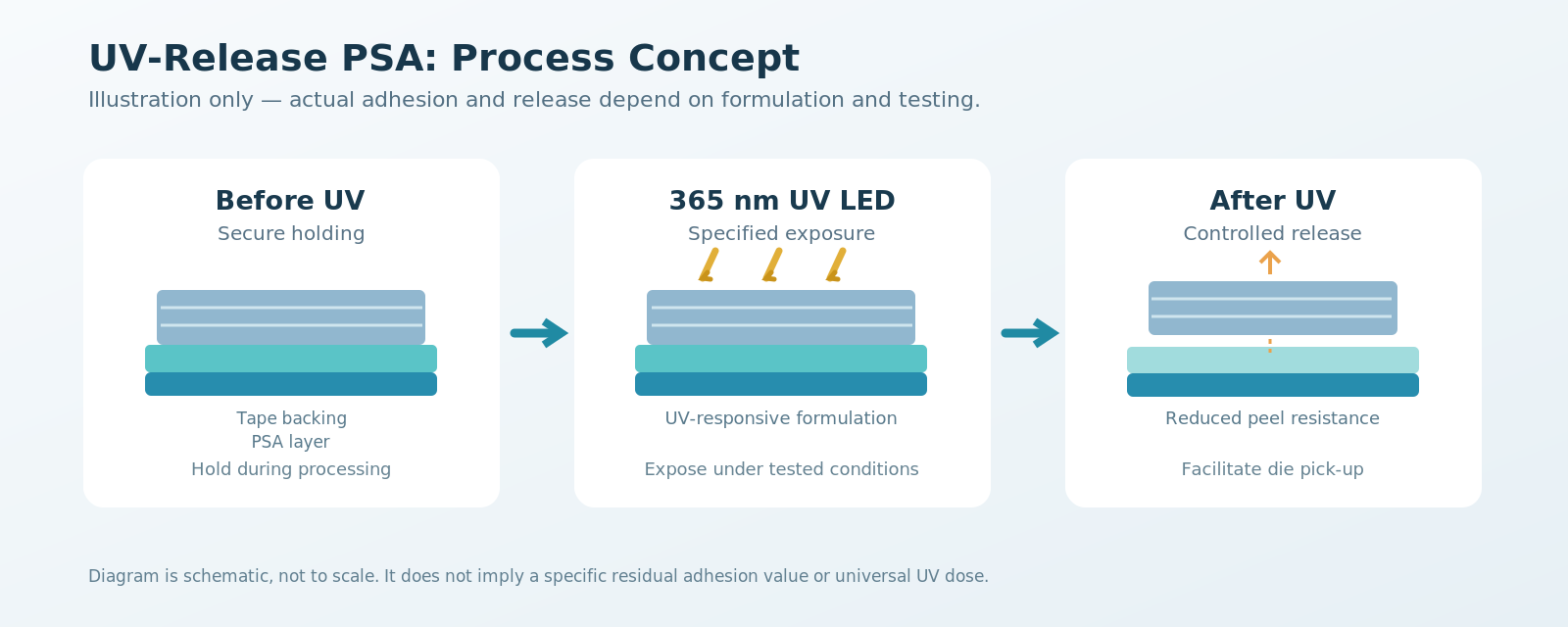
A UV-release PSA is formulated to provide holding strength during processing and reduce peel adhesion after exposure to the specified UV light. Before irradiation, the adhesive must help keep the wafer and separated dies in place. After suitable UV exposure, its reduced adhesion may facilitate die pick-up or tape removal.
An effective adhesive for dicing tape is not necessarily the formulation with the lowest possible post-UV peel force. The desired release level depends on die size, wafer surface, tape construction, handling method, and the customer’s defined process window. Some processes call for a small but controlled amount of remaining tack.
Important evaluation criteria include:
- Stable initial adhesion during wafer mounting, cutting, and handling
- Defined residual peel adhesion after UV exposure
- UV wavelength, measured irradiance, and exposure dose
- Adhesive coating thickness and uniformity
- Film substrate and surface-treatment compatibility
- Processing temperature, handling conditions, and removal cleanliness
Customizable UV-Release Formulation for Dicing Tape Manufacturers
Chemix Guru’s acrylic PSA systems can be formulated with a UV-Responsive Additive to evaluate controlled adhesion reduction. Our current UV-responsive component system is designed for 365 nm UV LED irradiation. A different irradiation wavelength may require a different UV-responsive formulation and separate validation.
Depending on the coating operation, the UV-responsive component may be incorporated during adhesive preparation or at a later formulation stage before coating. The UV-release formulation can be evaluated against different initial adhesion targets, post-UV peel requirements, film substrates, and UV exposure conditions.
Adjusting a formulation does not necessarily cause a proportional or predictable change in peel force or required UV dose. Each formulation and tape construction must be tested under representative manufacturing conditions.
Two Acrylic Adhesive Options for Dicing Tape Development
CG-18327 — Heat-Resistant Acrylic PSA with UV-Release Characteristics
CG-18327 is a solvent-based acrylic pressure-sensitive adhesive described as heat-resistant in its technical data sheet. Under the specified formulation and laboratory test conditions, its peel adhesion to glass decreases substantially after UV LED exposure.
CG-18327 may be evaluated for wafer dicing and thinning tape development. The descriptive term heat-resistant does not, by itself, establish suitability for a particular temperature-and-time exposure cycle.
CG-18329 — Acrylic PSA for Controlled UV-Release Applications
CG-18329 is an acrylic pressure-sensitive adhesive intended for UV-release applications. Under the specified laboratory test conditions, it shows a substantial decrease in peel adhesion to prepared mirror-finish steel after UV LED exposure.
It provides another candidate adhesive system for tape constructions requiring low post-UV peel adhesion. The reported upper limit does not guarantee that any particular nonzero residual tack level will be maintained.
Typical Technical Properties
| Property | CG-18327 | CG-18329 |
|---|---|---|
| Adhesive type | Solvent-based Acrylic PSA | Solvent-Based Acrylic UV-release PSA |
| Solid content | 45 ± 1% | 35 ± 1% |
| Viscosity at 25°C | 2,000 ± 800 cps | 3,000 ± 1,000 cps |
| Peel test surface | Glass | Prepared mirror-finish steel |
| Initial peel adhesion (20 min contact) | 0.6–1.0 kg/in | 1.0–1.2 kg/in |
| Post-UV peel adhesion | ≤ 0.030 kg/in | ≤ 0.010 kg/in |
| UV LED exposure dose | 500 mJ/cm² | 300 mJ/cm² |
| Tested adhesive thickness | 39–41 µm | 9–11 µm |
Technical note: Values are from product-specific formulation and laboratory test conditions. Different test surfaces and adhesive thicknesses were used, so these values should not be interpreted as a direct performance ranking. The CG-18329 technical data specify at least seven days of room-temperature aging before testing. Reported post-UV peel values are upper limits, not guaranteed residual-tack ranges. The supplied data do not specify a peel angle or test speed.
Film Substrates Evaluated in Development
Chemix Guru’s adhesive development and evaluation work has included PVC, PO, PET, and PI film substrates:
- PVC — Polyvinyl chloride
- PO — Polyolefin
- PET — Polyethylene terephthalate
- PI — Polyimide
These films differ in mechanical stiffness, thermal behavior, surface energy, and optical transmission. A substrate family having been evaluated does not mean that every CG-18327 or CG-18329 formulation has been qualified on every grade or film structure. Surface treatment, adhesive coat weight, and coating conditions remain important.
How to Select an Adhesive for Dicing Tape on Existing Equipment
Adhesive selection should begin with the actual production requirements, not with a single laboratory peel measurement. The intended tape must maintain sufficient holding force during singulation, then release at a suitable level for the downstream pick-up process.
UV irradiation conditions should also be compatible with equipment throughput. The test doses listed above, 300 and 500 mJ/cm² respectively, are laboratory conditions in the supplied technical data; they are not necessarily minimum doses for a different formulation, film, machine, or production cycle.
For example, an equipment trial should record the wavelength, effective irradiance at the tape surface, dose, exposure duration, and time between irradiation and peel testing. These conditions affect whether an adhesive for dicing tape can be integrated into an existing process without an unacceptable change in equipment cycle time.
For background on wafer singulation methods, see this technical review of semiconductor wafer dicing processes.
Frequently Asked Questions
Does UV-release mean the PSA becomes completely non-tacky?
Not necessarily. UV-release systems are designed to decrease adhesion under defined irradiation conditions. The final residual adhesion and tack depend on the formulation, exposure, test surface, and complete tape construction. Customers should specify a target range when some residual tack is required.
Can one peel adhesion value predict die pick-up performance?
No. A peel result on glass or prepared steel is useful as a controlled laboratory reference, but does not alone establish die pick-up, particle generation, or residue performance on a processed wafer. The finished tape must be validated with representative wafer materials and equipment.
Are the listed UV exposure doses guaranteed process settings?
No. The reported values are product-specific laboratory test conditions. Production conditions must be determined from the actual UV LED spectrum, irradiance, film transmission, adhesive thickness, and target residual adhesion.
Discuss Your Dicing Tape Adhesive Requirements
Chemix Guru provides acrylic PSA raw materials and formulation evaluation support for manufacturers of specialized semiconductor tapes. Explore our electronics-related adhesive applications or contact Chemix Guru to discuss film substrate, initial peel strength, post-UV adhesion targets, UV equipment, and coating conditions.
Need an adhesive for dicing tape with controlled UV-release behavior? Contact our team to discuss a suitable evaluation plan.
Final adhesive and finished-tape performance must be verified under the intended manufacturing and end-use conditions. The illustrations in this article are conceptual, not tested product photographs.