
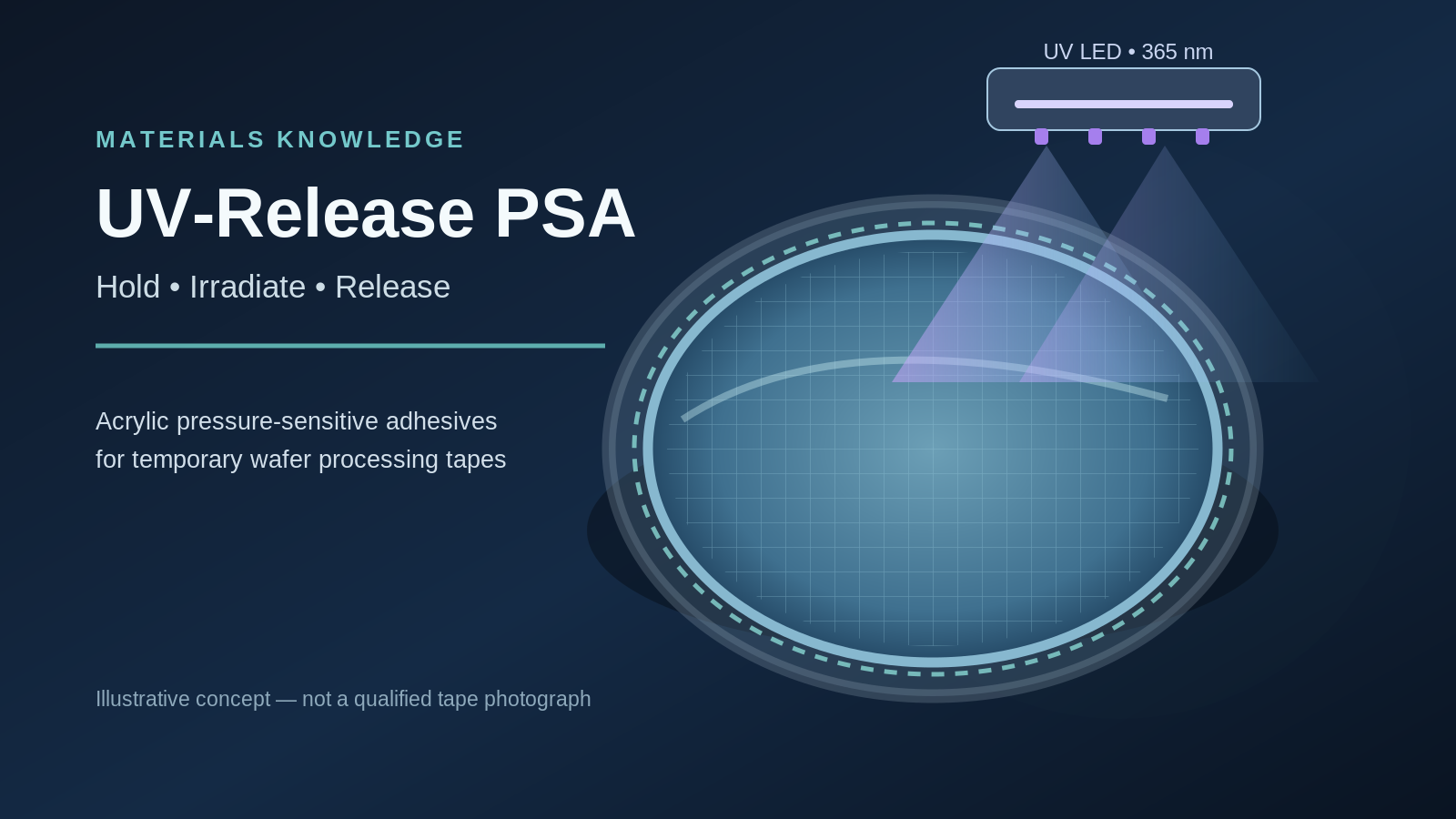
Why wafer-dicing tapes hold firmly during processing and release more easily after UV exposure
What Makes UV-Release Pressure-Sensitive Adhesives Different?
UV-release pressure-sensitive adhesives (PSAs) are intended for jobs where a temporary bond must change during the process. Wafer dicing is a useful example: the tape needs to hold the wafer and separated dies in place during cutting, but it should not resist die pick-up with the same force afterward.
A conventional PSA is selected for its adhesion under particular contact and removal conditions. A UV-release PSA adds another control: after exposure to an appropriate UV source, the adhesive system is designed to show lower peel adhesion. The exact response depends on the formulation, the tape construction and how the UV light is delivered.
For tape manufacturers evaluating UV-release pressure-sensitive adhesives, the practical question is how much adhesion remains after exposure and whether that result can be reproduced on the intended production line.
Five Stages of a UV-Release Dicing Tape Process
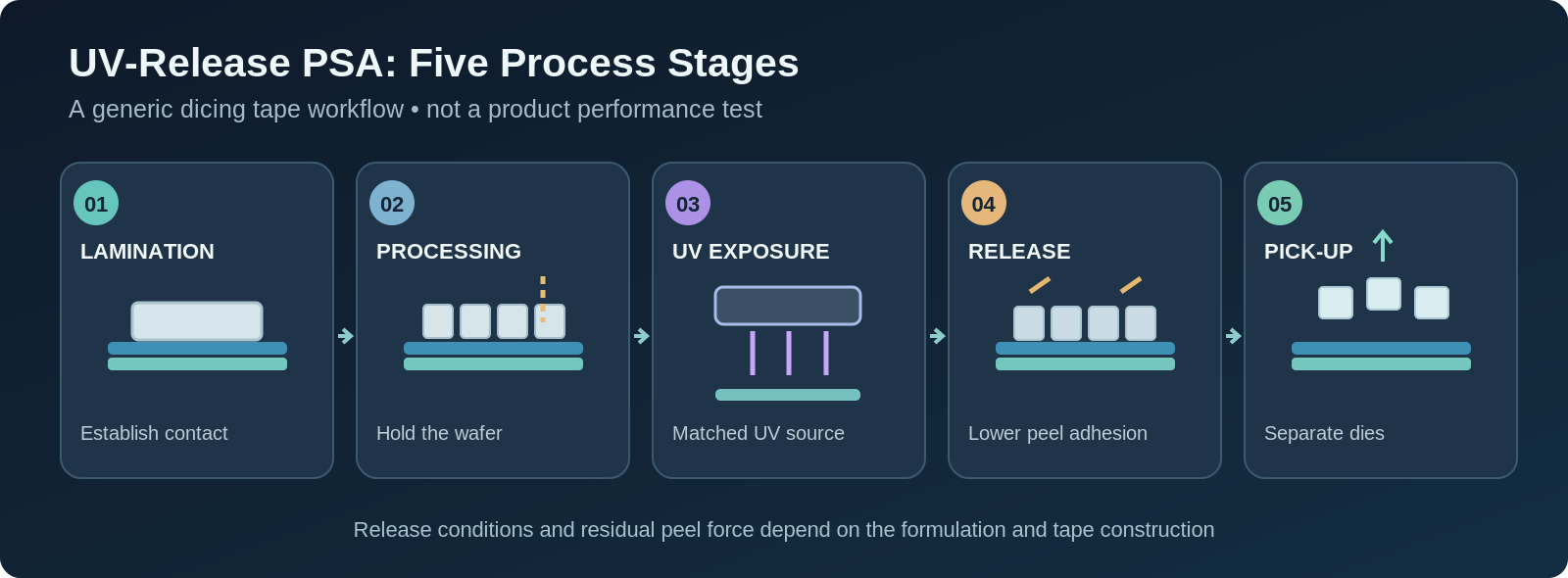
The five stages below show where UV-release pressure-sensitive adhesives must hold the wafer and when the process calls for lower peel adhesion.
1. Lamination
The wafer is mounted onto the dicing tape. Sufficient contact and initial peel adhesion are needed to secure the wafer without introducing unwanted stress or trapped air. Film properties, adhesive thickness, lamination conditions and wafer surface condition all affect this step.
2. Wafer processing
During singulation, the adhesive holds the wafer and the individual dies in position. The required holding force depends on the cutting method, die dimensions and other process details; greater adhesion is not automatically better in every case.
3. UV exposure
The mounted tape is exposed to a UV source matched to the adhesive system. Light must reach the responsive portion of the adhesive through the relevant tape layers. A nominal lamp setting alone is not sufficient to describe the energy actually received at the adhesive.
4. Adhesion reduction
After the specified exposure, the adhesive is intended to have lower peel adhesion. Depending on the chemistry, light-triggered reactions may alter the polymer network or the adhesive’s interfacial behavior. The mechanism and reduction level should not be assumed identical across different formulations.
5. Die pick-up or tape removal
Lower residual adhesion can make the next separation step easier. The suitable endpoint is a controlled residual adhesion range, rather than necessarily zero tack. Excessive residual adhesion can obstruct pick-up; insufficient retention may be undesirable in some handling sequences.
For material selection in wafer dicing, see UV-Release Acrylic Adhesive for Dicing Tape. It discusses how to evaluate holding before UV exposure and peel adhesion after exposure under defined test conditions.
Is UV Release the Same as UV Curing?
Not the same. These terms describe different things:
- UV curing describes a light-triggered chemical process used to cure or crosslink a material.
- UV release describes the intended application result: lower adhesion after irradiation, at the stage when separation is required.
The distinction is about function, not an absolute separation between chemistries. Some UV-release dicing tape systems reduce adhesion through UV-initiated crosslinking and are also described technically as UV-curable tapes. However, an adhesive that is UV-cured during manufacture is not automatically a UV-release product for wafer processing.
For a separate discussion of UV curing in PSA production, see our existing overview of UV pressure-sensitive adhesives. This article focuses on release behavior during use.
Independent research on photoreactive acrylic PSAs for wafer dicing illustrates how UV-induced changes can lower peel adhesion. It is background research, not a measurement of Chemix Guru products.
Why UV Wavelength and Dose Matter
When evaluating UV-release pressure-sensitive adhesives, check the light source against the response of the photoreactive components. A formulation may react differently to sources with different spectra.
Chemix Guru’s current UV-responsive additive system is designed for 365 nm UV LED irradiation. A different wavelength may require a different formulation approach and its own validation. It would not be appropriate to assume the same material responds identically to every UV lamp.
UV exposure conditions also affect the usable process window. Relevant variables include:
- The actual spectrum and UV irradiance at the tape
- Exposure duration and accumulated UV dose
- Film transmission, coating thickness and tape orientation
- Temperature during exposure
- The interval between irradiation and peel measurement
A target exposure dose should not be interpreted as a universal recipe. Even if two setups deliver the same nominal energy density, they may not produce the same adhesive response. The separate Knowledge article on UV dose and equipment cycle time will examine this relationship in greater detail.
Why Residual Adhesion Needs a Test Method
Peel adhesion for UV-release pressure-sensitive adhesives is often reported as a force per unit width. A value is useful only when the measurement conditions are also known.
Consider two reported post-UV results. If one was measured on glass and another on a prepared metal panel, or if the adhesive thicknesses differ, their numbers do not establish a direct ranking of release performance.
When a customer specifies a residual adhesion target, the test plan should define:
| Test parameter | Why it needs to be stated |
|---|---|
| Contact surface | Surface energy and finish affect peel readings |
| Adhesive and backing thickness | Changes contact mechanics and response to UV |
| Peel angle and speed | Can change measured peel force |
| UV wavelength, irradiance and dose | Defines the irradiation condition |
| Conditioning and time after UV | Helps make repeat measurements comparable |
| Acceptable adhesion range | Captures whether some residual tack is required |
For instance, a request for less than 10 gf/in after UV exposure is incomplete unless the test surface and method are specified. It is also an application requirement, not a universal dicing-tape standard or a performance claim for every adhesive grade.
Adjusting a UV-Release Formulation
Chemix Guru develops acrylic pressure-sensitive adhesives for coating and tape manufacturers. Where UV release is required, an acrylic PSA can be evaluated with a UV-Responsive Additive selected for the intended irradiation conditions.
Depending on the coating operation, the UV-responsive component may be introduced during adhesive preparation or at a subsequent formulation stage before coating. Its level can be evaluated against the required initial holding force, post-exposure peel adhesion and allowable irradiation conditions.
The relationship is not necessarily linear. More additive does not automatically mean proportionally lower adhesion or a lower required dose. Formulation changes can also influence coating behavior, adhesive cohesion and the balance between adhesion and release.
A useful development trial therefore compares coated samples made under defined conditions, rather than changing several variables at once.
A Short Qualification Checklist
Before choosing UV-release pressure-sensitive adhesives for a semiconductor tape design, establish the following:
- Before UV: What holding force is needed during lamination, cutting and handling?
- After UV: What peel range is acceptable, and is some tack required?
- Light source: Is the equipment operating at 365 nm, or another wavelength?
- Tape construction: Which backing film and dry adhesive thickness will be used?
- Test conditions: What substrate, peel method and time after exposure will be used?
- Line integration: Does the required exposure fit the available equipment cycle?
A specification built around these questions gives both the adhesive supplier and the coating manufacturer a clearer basis for comparison.
Discuss Your UV-Release PSA Requirements
Selecting UV-release pressure-sensitive adhesives means balancing wafer holding strength and predictable release. Treat the irradiation conditions as part of the material specification.
Chemix Guru can discuss acrylic PSA formulation options for tape manufacturers evaluating semiconductor dicing and other temporary protection applications. Start with the tape structure, the intended UV source and the initial and residual peel-adhesion requirements.
Contact Chemix Guru to discuss your evaluation conditions, or browse our Knowledge articles for related adhesive testing topics.
Application note: This article describes general technical principles and formulation options. It is not a claim of universal substrate compatibility, residue-free release, thermal endurance, or finished-tape qualification. Performance must be validated under the intended test and production conditions.