
Five Critical PSA Considerations for Wafer Protection, Grinding Stability, and Controlled Removal
Selecting the right Adhesive for Back Grinding Tape
Choosing the right adhesive for back grinding tape involves more than finding a pressure-sensitive adhesive (PSA) with strong initial peel adhesion. During semiconductor wafer thinning, the tape must help protect the device-bearing surface while the opposite side of the wafer is ground to a specified thickness. The adhesive is one component of a protective structure that may also include a backing film and, in some designs, additional functional layers.
Chemix Guru provides acrylic pressure-sensitive adhesives (PSAs) for tape manufacturers evaluating semiconductor wafer protection materials. Our role is to supply adhesive materials and support formulation evaluation—not to claim that our PSA alone constitutes a finished, qualified back grinding tape.
What Happens During Wafer Back Grinding?
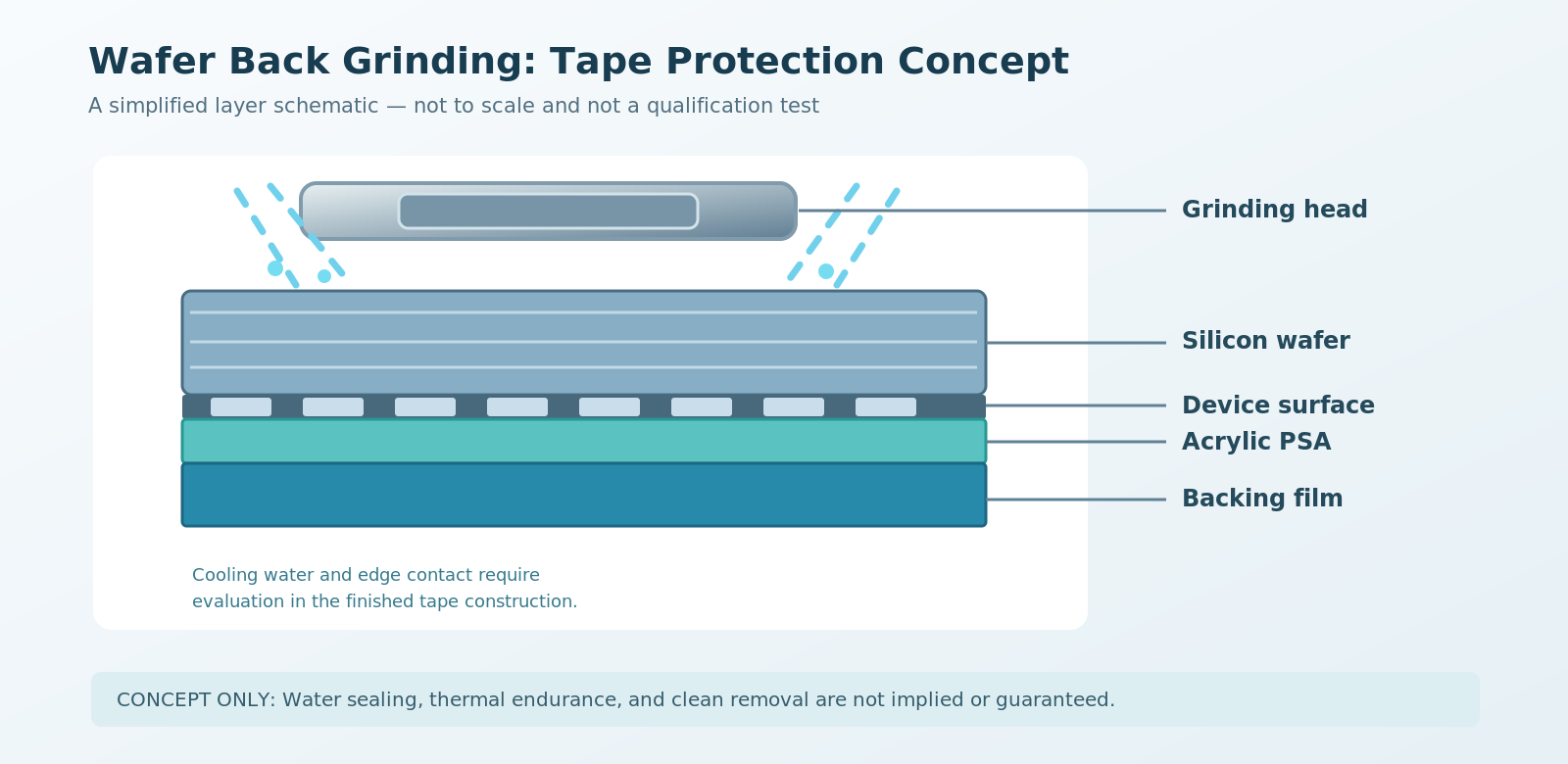
A protective tape is laminated to the front, device-bearing face of a wafer before the exposed back side is ground. Grinding may involve contact pressure, vibration, abrasive particles, and cooling water. The wafer is typically much thinner afterward, so the conditions used for tape removal may also be important.
Back grinding tape (BG tape) therefore has two linked responsibilities: protect the wafer surface during processing and allow removal at the appropriate stage. Finished-tape design must account for the behavior of the entire construction, including film, adhesive, coating thickness, lamination, and edge contact.
Five Essential Requirements for an Adhesive for Back Grinding Tape
1. Reliable Surface Contact and Holding Strength
The adhesive must help maintain intimate contact between the protective tape and the device-bearing wafer surface. Insufficient contact may create voids or local lift-off, while excessive adhesion can complicate removal from a thinned or delicate wafer.
A suitable initial peel value is application-specific. The relevant wafer finish, surface topography, contact time, lamination pressure, and test method all influence the result. Measurements made on glass or polished steel are useful formulation references but cannot alone establish adhesion to a processed wafer.
2. Water Exposure and Edge Integrity
Cooling water is commonly used during grinding. Tape manufacturers must evaluate whether the finished construction can maintain protection and limit water ingress near the wafer edge and around imperfectly laminated areas.
Water performance is a system-level requirement, not a property guaranteed by selecting an acrylic PSA. Film characteristics, coating continuity, tape dimensions, surface conformity, and edge sealing may all affect the result. A controlled water-exposure or grinding simulation is more informative than a room-temperature peel test alone.
3. Coating and Total Thickness Uniformity
Thickness variation in the protective tape may influence the mechanical support and grinding outcome. Adhesive coat weight, drying uniformity, film thickness, and any cushioning layer should therefore be evaluated together.
For wafers with raised features such as solder bumps or copper pillars, a more compliant layer or a specialized multilayer construction may be required. That design question is separate from the PSA’s nominal initial adhesion and needs representative topography testing.
4. Thermal Stability Under Actual Conditions
Some semiconductor processing sequences specify elevated temperatures. A customer may, for example, ask for performance after 150°C for one to two hours. That is a potential qualification condition, not an established performance rating for the Chemix Guru products discussed here.
A meaningful thermal evaluation should check adhesion retention, cohesive behavior, creep, backing-film distortion, residue, and removal after the complete heat cycle. An adhesive described as heat-resistant is not automatically qualified for a particular temperature-and-time profile.
5. Controlled Removal and Surface Cleanliness
After thinning, the tape must be removed without applying excessive stress to the wafer. Residual adhesive or other surface contamination may interfere with later steps, so cleanliness should be assessed by an agreed test method rather than assumed from low peel values.
Some BG tape constructions use UV-release PSAs to reduce adhesion before removal; others use non-UV systems. The choice depends on the equipment, the complete tape structure, and the downstream process.
UV-Release and Non-UV Back Grinding Tape Designs
UV-release BG tape uses a light-responsive adhesive system to reduce adhesion after exposure under specified UV conditions. Its suitability depends on film transmission, light wavelength, measured irradiance, target UV dose, and the required residual adhesion.
Non-UV BG tape relies on a different removal strategy and may be appropriate where UV exposure is not part of the equipment sequence. Neither approach is inherently suitable for every wafer and production line.
Chemix Guru’s current UV-responsive formulation is designed for 365 nm UV LED irradiation. The UV-Responsive Additive can be incorporated during adhesive preparation or evaluated at a later formulation stage before coating, depending on the coating process. Adjustments may be investigated to approach a target release behavior, but no change in additive level guarantees a predictable decrease in dose or peel force without testing.
CG-18327 and CG-18329: Acrylic PSA Candidates for Evaluation
Chemix Guru offers CG-18327 and CG-18329 as acrylic PSA options for manufacturers evaluating UV-release semiconductor tape constructions. Both products have documented reductions in peel adhesion under their respective laboratory UV exposure conditions.
- CG-18327: A solvent-based acrylic PSA described as heat-resistant in its technical data. Its laboratory data support UV-release evaluation for wafer dicing and thinning-related tape development.
- CG-18329: A solvent-acrylic UV-release PSA with low post-exposure peel adhesion under its specified laboratory test conditions.
Important limitations: These laboratory tests use different peel-test surfaces and coating thicknesses. They do NOT establish that either product has passed a BG tape grinding-water test, a 150°C × 1–2 hour endurance test, a wafer residue test, or a finished-tape thickness-uniformity specification.
The current technical data are a starting point for application-specific tape development, not a guarantee of back grinding qualification. The appropriate UV-release formulation and coating construction must be validated on the intended wafer and equipment.
Film Substrate and Construction Considerations
Chemix Guru’s adhesive evaluation work has included PVC, PO, PET, and PI films. However, evaluation of a substrate family does not mean every adhesive formulation or individual film grade has been qualified for back grinding.
For a new tape design, the coating manufacturer should define the substrate grade, surface treatment, adhesive thickness, lamination conditions, and complete temperature and water-exposure history. The finished tape—not the PSA in isolation—must meet the wafer manufacturer’s protective and removal requirements.
An independent technical article on backgrind tape material design also discusses the importance of tape thickness, wafer protection, and residual contamination when evaluating these materials.
How to Evaluate an Adhesive for Back Grinding Tape
Before selecting an adhesive for back grinding tape, prepare a testing brief with clear acceptance criteria:
- Wafer surface: Material, surface finish, device features, and any bump geometry.
- Tape construction: Backing type, adhesive coating thickness, total thickness, and coating uniformity.
- Lamination: Pressure, temperature, dwell time, and edge-contact requirements.
- Grinding exposure: Coolant chemistry, duration, applied loads, and target final wafer thickness.
- Thermal history: Maximum temperature, hold time, and any repeated heating cycles.
- Removal: UV or non-UV process, peel adhesion target, residue criteria, and wafer-damage checks.
A practical test plan should record failures as well as successful results and should avoid treating one laboratory measurement as proof of the entire protective process.
Frequently Asked Questions
Is a UV-release adhesive required for every back grinding tape?
No. Both UV-release and non-UV constructions are used in semiconductor protection. The appropriate release method depends on the equipment, wafer surface, process flow, and tape design.
Does lower post-UV peel adhesion prove that the tape will leave no residue?
No. Low peel adhesion and clean removal are related but distinct properties. Residue testing on representative wafer surfaces is required to establish a cleanliness claim.
Can a heat-resistant acrylic adhesive automatically withstand 150°C for two hours?
No. Heat resistance must be quantified using the actual temperature, dwell time, and construction. Existing product descriptions alone do not support this qualification.
Can the same PSA be used for dicing tape and BG tape?
An acrylic PSA may be investigated for both applications, but the processing priorities differ. Wafer dicing emphasizes fixation and die handling; back grinding additionally requires evaluation of coolant exposure, protective contact, tape geometry, and wafer thinning. Qualification for one process does not establish qualification for the other.
Discuss Your Back Grinding Tape Adhesive Requirements
Chemix Guru works with coating and tape manufacturers evaluating acrylic pressure-sensitive adhesives for demanding electronics-processing applications. Visit our electronics-related adhesive applications or contact Chemix Guru to discuss substrates, initial adhesion, water exposure, thermal history, UV-release conditions, and testing priorities.
Developing an adhesive for back grinding tape? Contact our team to define the requirements for a targeted material evaluation.
Technical disclaimer: Described process conditions are application examples, not certified properties of CG-18327 or CG-18329. Water resistance, temperature endurance, residue performance, and finished-tape suitability require independent testing under actual manufacturing conditions. All figures are original conceptual illustrations and are not photographs of tested Chemix Guru products.